

A Practical Guide for Founders and Finance Leaders
An Annual Operating Plan (AOP) is where strategy stops being a conversation and becomes a set of commitments for the coming year. It names the few things the company will actually pursue, the work that will get you there, and the numbers you agree to be measured against. Every financial decision you make next year traces back to it. A good AOP also settles arguments before they start, because product, engineering, sales, marketing, and customer success are all working from the same document.
It also explains your numbers. Any investor can read a revenue projection. What they want to know is why you believe it. Your board will ask that question in some form at every meeting, and the AOP is what lets you answer it the same way twice, whether you are in a board deck, a lender conversation, or a fundraise.
Stage matters more here than most planning advice admits. A seed company still hunting for product-market fit and a Series B company scaling a sales team are solving different problems, and their plans should not look alike. We flag those differences as they come up.
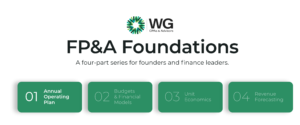
This article is the first in a four-part series on financial planning for technology companies:
Part 1: How to build an annual operating plan
Part 2: How to build a financial model and budget
Part 3: Understanding your industry business model
Part 4: How to forecast revenue
For a broader overview of FP&A fundamentals, see our primer on financial planning and analysis for business growth.
________________________________________________________________________
Step 1. Take an Honest Look at Where You Are
Planning starts with an honest read on the present. For a SaaS business that means looking past the income statement and balance sheet to the things that actually determine next year: whether the business model still works, where you stand against competitors, and how solid the customer base really is.
Business Model Health Check:
Start with last year’s plan and compare it to where you actually ended up. Which product milestones did you hit, which slipped a quarter, and which came off the roadmap without anyone formally deciding to drop them? If a release you were counting on shipped late, or shipped on time and did not change customer behavior the way you expected, that tells you something about the assumptions you are carrying into next year.
Market and Competitive Landscape:
Technology markets move fast enough that last year’s read is already stale. Look at who entered the market, who left, and what buyers now treat as table stakes. Ask whether the market is still growing or starting to consolidate, since that answer decides whether you should be spending to capture share or protecting margin. Build the plan around the market you are in, not the one you would prefer.
Team and Organizational Capacity:
Then look at the team. Do you have the people to do what you are about to write down, and if not, what is missing? Plans rarely come apart because the strategy was wrong. They come apart because nobody had the capacity to execute them. Naming the gaps now means the hiring and training land in the plan, instead of surfacing in April as a surprise.
Customer and Customer Acquisition Health:
Now the numbers. Retention and acquisition both belong in this review, and they answer different questions. MRR trend, churn, net revenue retention, and expansion revenue tell you whether the base you already have is holding. CAC, CLTV to CAC, payback period, and win rate by segment tell you what it now costs to add to that base, which is usually where the unpleasant surprises live. Pre-revenue companies can stand in engagement data, pilot feedback, and early adoption patterns until there is revenue to measure. And if none of this is being tracked, that is worth knowing too. Start with a monthly view of recurring revenue, customer count, logo churn, and new bookings, rebuild what history you can from invoices, contracts, and the billing system, and then put the tracking work into the plan as its own initiative, because you will want that history next year.
If this is your first AOP, lean on your own record rather than published benchmarks. Bookings, realized pricing, sales cycle length, and what it cost to land each new customer are already sitting in your invoices and your CRM, and any of them can be adjusted for what you expect to change. Benchmarks are worth a look once you have a number of your own to compare against. A median drawn from companies with different pricing and different buyers is not something to build a plan on.
________________________________________________________________________
Step 2. Set Your Goals for the Stage You Are In
With that assessment in hand, pick three to five goals for the year. Five is a ceiling, not a target. These sit above the departments, and every function should be able to point to how its work supports one of them. What belongs on the list depends on where you are:
Pre-Seed and Seed: Finding and Proving the Model
- Achieving product-market fit: Decide what fit looks like in numbers before you plan around it. Retention at a given month, weekly usage, referral rate, and NPS all work. What matters is picking the measures you will accept as proof, then building the year around hitting them.
- Proving the revenue model: Show that customers will pay a price that supports a real business. In practice that means setting initial pricing, watching what converts at that price, and generating enough revenue for an investor to underwrite.
- Capital-efficient experimentation: The plan should read like a series of tests rather than a straight line. You are trying channels, pricing models, and segments, and the budget needs to leave enough runway for the iterations it takes to find the combination that works.
- Managing burn to investor milestones: Tie spending to the metrics that unlock the next round. Map runway against the milestones your investors need to see, and be honest about whether the two line up.
Series A: Scaling What Works
- Building a repeatable go-to-market motion: Move from founder-led selling to something that works without the founder in every deal. That means writing down the sales process, hiring the first dedicated reps, and choosing channels whose returns you can actually measure.
- Demonstrating unit economics: Prove that acquisition cost, lifetime value, and retention hold together. Investors at this stage are looking for evidence that a dollar spent on growth comes back, predictably, with something on top.
- Putting the first infrastructure in place: Invest in the systems and processes behind finance, HR, and customer success now, while the cost of doing it properly is still low. Skipping this stage is how companies accumulate organizational debt.
Series B and Beyond: Optimizing and Scaling
- Maximizing customer lifetime value: Attention shifts to keeping and growing the customers you already have. Cutting churn and lifting expansion revenue are usually the two highest return activities available to a scaling SaaS company, and net revenue retention above 100% means the installed base grows even in a quarter with no new logos.
- Scaling revenue efficiently: New segments, new geographies, and larger accounts all belong here, alongside the less glamorous work of making acquisition cheaper without letting unit economics slip.
- Showing a path to profitability: Investors now expect to see how unit economics improve as you scale and when the company reaches cash flow breakeven. Vague answers get expensive at this stage.
- Building organizational infrastructure: Growth needs systems, processes, and people behind it, which in practice means accounting and finance infrastructure, reporting that leadership trusts, and compliance frameworks that hold up under diligence.
________________________________________________________________________
Step 3. Turn Each Goal Into Something You Can Measure
Each goal needs to become a small number of objectives with results specific enough to argue about. SaaS companies have an advantage here, because a subscription model produces monthly data on almost everything that matters, which makes progress unusually easy to see.
For each goal, decide:
- The target outcome: What does success look like in December? Be specific enough that nobody can claim credit for a near miss. “Grow revenue” is not an objective. “Reach $5M ARR by December with net revenue retention above 110%” is.
- Leading indicators: Find the numbers that move before the financials do. Pipeline generation and qualified lead volume tell you about revenue two quarters out. Onboarding completion and product adoption tell you about retention long before a renewal date arrives.
- Ownership: Every objective needs one name against it at the leadership level. Not a committee, and not a department. One person who answers for the result and pulls the other functions along.
- Quarterly milestones: Break the annual target into four checkpoints. Monthly data means you can watch progress continuously, but a formal quarterly review is what actually forces a course correction while there is still time to make one.
________________________________________________________________________
Step 4. Connect Departmental Work to the Goals
This is the point where the plan stops being a leadership document and starts being everyone’s. Each department names the specific work it will do in service of the company goals.
- Product and Engineering: Which features, platform improvements, and technical investments make the cut? How does the roadmap connect to retention, expansion, and competitive positioning? Be blunt about the trade-offs. You cannot build everything, so the question is which investments earn their place.
- Sales: What is the go-to-market plan, which segments are you targeting, and how much pipeline coverage does the number require? A company moving upmarket may need account-based selling. A product-led company is more likely to be working on self-serve conversion.
- Marketing: Which channels get the investment, and what do you expect back in qualified leads and pipeline? Marketing also owns the content and thought leadership that decides whether buyers see you as a credible option before a rep ever calls.
- Customer Success: Which programs will actually move retention and expansion? Onboarding, health scoring, proactive outreach, and expansion plays all belong here, along with a clear method for spotting a churn risk while there is still time to fix it.
- Finance and Operations: What has to be built to support the growth you are planning? Usually this means the reports and financial model that measure performance against the goals in the plan, so leadership can see each month whether the company is on track, plus the compliance groundwork that matters as audit readiness approaches.
________________________________________________________________________
Step 5. Find the Dependencies and Risks Early
Nothing in a SaaS company happens in one department. Sales cannot close against features marketing has been promoting until engineering ships them, and customer success cannot hold retention without those same improvements. The plan has to name these handoffs, because that is where the year usually gets away from you.
For each major initiative, write down:
- Which other teams or resources the initiative depends on, and whether those teams know about it and have agreed to it.
- What could derail it from outside: a market shift, a competitor’s move, a regulatory change, or the broader economy.
- What you will do if a core assumption turns out to be wrong. This matters more in SaaS than most industries, where one large customer leaving or one delayed launch can reshape the whole year.
- Which hiring or capability gaps have to close first, and by when. A familiar way to lose a year is to plan Q2 initiatives that depend on Q1 hires nobody has approved.
________________________________________________________________________
Step 6. Decide How You Will Review It
A plan nobody revisits is a document, not a management tool. Technology companies move quickly enough that something written in November will need adjusting by March, and the only question is whether that adjustment happens deliberately or by accident.
So build the review process into the plan itself:
- Monthly operating reviews: Leadership looks at progress against the objectives every month, weighted toward the leading indicators. These meetings should produce decisions. If the hour ends with nothing but a status update, the meeting was reporting, not managing.
- Quarterly check-ins: Step out of the operating detail and ask whether the goals themselves still hold, given what the last three months taught you. SaaS companies generate more data than they use. This is the moment to spend it on validating or replacing your assumptions.
- Board reporting: Organize board materials around the same goals and objectives. It keeps your story consistent, makes progress easy to see quarter over quarter, and builds the kind of credibility that comes from setting a target publicly and then reporting against it either way.
- Re-forecasting triggers: Decide in advance what would force a re-forecast. Missing revenue by more than a set threshold, losing a major customer, or a genuine market shift all qualify. Agreeing on the triggers up front is what keeps a leadership team from either ignoring a warning sign or panicking over ordinary variance.
________________________________________________________________________
Step 7. Build the Financial Model and Budget Behind It
The plan and the financial model answer different halves of the same question. The plan says what you are going to do and why. The model says what it costs and what it produces. The link between them should be traceable: every line in the model ought to map back to a specific initiative or operating requirement in the plan. Built properly, the model carries most of the weight. It produces the budget itself, converting goals and initiatives into the revenue, headcount, and spend lines you will actually manage to, and then reports against those same lines month by month, tracking the KPIs and goals you set and putting actuals next to plan. That model also carries forward, so next year’s planning cycle opens with twelve months of real results in a working file rather than a blank page.
The connections that matter most for a SaaS business:
- Customer acquisition, retention, and expansion assumptions in the model drive the revenue targets
- Go-to-market plans become sales and marketing headcount and program spend
- Roadmap priorities drive engineering headcount and infrastructure cost
- Customer success programs set the investment in retention and expansion
- Cash objectives shape billing terms, fundraising timing, and how quickly you spend
Our companion guide, How to Build a Financial Model and Budget for SaaS and Technology Companies, walks through that build in detail.
________________________________________________________________________
Conclusion: What a Good Plan Actually Buys You
An operating plan earns its keep long after the planning season ends. It gives the team one version of the year, gives investors a reason to trust your numbers, and gives you something to hold people to when priorities start competing in March. Maintained honestly, it becomes the document leadership actually runs the company from.
The technology companies that outperform over time are not the ones with the most accurate forecasts. Nobody forecasts a year correctly. They are the ones who did the thinking early, so that when conditions changed they already knew which assumptions were load bearing and could decide quickly instead of arguing from scratch.
This is the first of four articles. Part 2 turns the operating plan into a working financial model and budget, translating goals and metrics into monthly revenue, headcount, and spend. If you have any questions, learn more about how we work with SaaS and technology companies or reach out to a WG advisor.